

When Do You Need a Flood Risk Assessment?
A clear guide to when a Flood Risk Assessment is required for planning — and what it includes.
What Is a Flood Risk Assessment?

A Flood Risk Assessment (FRA) evaluates the likelihood of flooding at a site and examines its potential impact on people, property and the environment. It is a technical report submitted as part of a planning application to demonstrate that a development will be safe from flooding and will not increase flood risk elsewhere.
The National Planning Policy Framework (NPPF) and Planning Practice Guidance set out clear requirements for when an FRA is required and what it must demonstrate. Local Planning Authorities use FRAs to apply the Sequential Test and, where necessary, the Exception Test to ensure development is directed away from areas at highest risk.
An FRA is not just a regulatory requirement — it's a vital tool for understanding what flood risks exist at your site and what mitigation your development needs to remain safe throughout its lifetime.
An FRA Assesses All Sources of Flood Risk
- Fluvial flooding — rivers and watercourses
- Tidal flooding — coastal and estuarial waters
- Surface water flooding — overland flow
- Groundwater flooding — rising water tables
- Sewer flooding — overwhelmed drainage
- Reservoir flooding — dam or reservoir failure
When Is a Flood Risk Assessment Required?
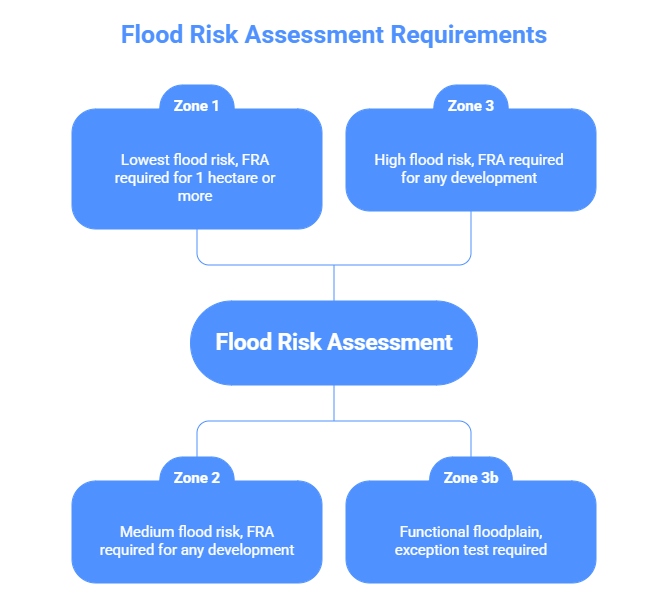
Under the NPPF and Planning Practice Guidance, a Flood Risk Assessment is required in the following circumstances:
Development in Flood Zone 2
Flood Zone 2 has a medium probability of flooding (1 in 100 to 1 in 1,000 annual chance). Any development in FZ2 requires an FRA regardless of size.
Development in Flood Zone 3
Flood Zone 3 has a high probability of flooding (greater than 1 in 100 annual chance). All development requires an FRA. Housing may also require an Exception Test.
Sites Over 1 Hectare in Flood Zone 1
Even in low-risk Flood Zone 1, sites over 1 hectare require an FRA to demonstrate drainage is adequate and runoff won't overwhelm watercourses downstream.
Major Developments (10+ dwellings)
Major applications — 10+ homes, residential sites over 0.5ha, or non-residential floorspace over 1,000m² — require an FRA in any flood zone.
Change of Use to More Vulnerable Use
Converting commercial to residential use in a flood risk area, or any change to a more vulnerable classification, typically requires a new Flood Risk Assessment.
Flood Consequence Assessment (Wales)
Developments in Wales within DAM B, C1 or C2 zones require a Flood Consequence Assessment under TAN15 (2024). We cover both England and Wales.
Why Is an FRA Important?
Regulatory Compliance
The NPPF requires LPAs to apply the Sequential Test to ensure development is steered away from flood risk areas. A well-prepared FRA is the technical evidence demonstrating your development is appropriate for its location.
Protecting Lives and Property
An FRA identifies site-specific flood hazards and recommends practical, cost-effective mitigation — raised floor levels, flood resilience measures, flood barriers — to protect future occupiers.
Avoiding Costly Surprises
Identifying risks at the outset allows mitigation costs to be factored into your scheme early, rather than discovered as expensive redesigns late in the process.
Environmental Responsibility
A good FRA integrates SuDS drainage design to manage surface water sustainably, improving biodiversity and protecting water quality in receiving watercourses.
Insurance and Finance
Lenders and insurers increasingly require flood resilience evidence. A thorough FRA demonstrating that risks have been assessed and mitigated can make it easier to secure favourable terms.
Planning Approval
A technically robust FRA written to address your LPA and LLFA requirements significantly reduces the risk of flood risk objections delaying your planning approval.
All Services & Resources
Everything you need for flood risk, drainage and environmental planning consultancy across England and Wales.
Flood Risk
Drainage
Other Services
Areas Covered
Frequently Asked Questions
Trusted by Developers, Architects & Planning Consultants
“Antony was great to work with when we needed a Flood Risk Assessment and Emergency Flood Plan. As an architect I would definitely use FRE Consultants again — professional and produced reports within a good time frame.”
“The service received was great and at a competitive cost. We were granted planning after first submission.”
“Fast, technically thorough and understood exactly what the LLFA needed. Approved without any queries. Highly recommended for any flood risk or drainage work.”
Get a Free Quote
Free, no-obligation fixed-fee quote within 24 hours. All flood zones and LLFAs covered.
Get a Free QuoteOr contact us directly: 07826 705389 •