

S23 Ordinary Watercourse Consent Applications
Works to ordinary watercourses require S23 consent from your LLFA. We prepare and submit complete applications on your behalf.
What Is an S23 Ordinary Watercourse Consent?
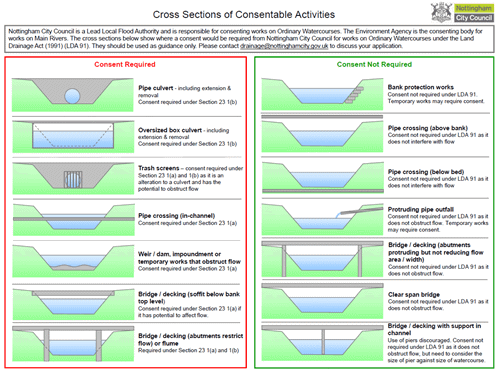
Section 23 of the Land Drainage Act 1991 makes it a legal requirement to obtain formal consent from your Lead Local Flood Authority (LLFA) before carrying out any works that would obstruct or alter the flow of an ordinary watercourse.
An ordinary watercourse is any watercourse that is not a designated main river — including streams, ditches, drains, cuts and culverts. Works requiring S23 consent include culverting, bridging, diverting, widening, deepening, realigning or otherwise altering an ordinary watercourse.
Important: Carrying out works to an ordinary watercourse without S23 consent is unlawful. LLFAs have enforcement powers requiring the removal of works and restoration of the watercourse at the landowner's expense.
We prepare complete S23 applications including supporting hydraulic calculations, drainage plans and environmental evidence to secure consent from your LLFA as quickly as possible.
Discuss Your ProjectWhen Is S23 Consent Required?
S23 consent is needed before carrying out any of the following works to an ordinary watercourse:
Culverting
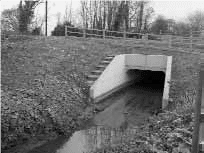
Enclosing an ordinary watercourse in a pipe or culvert — typically to create an access or allow development over a watercourse. LLFAs generally discourage culverting and require hydraulic evidence that the culvert is adequately sized.
Bridging
Constructing a bridge or culvert for vehicular or pedestrian access across an ordinary watercourse. Must demonstrate adequate hydraulic capacity for the design flood event.
Diversion or Realignment
Diverting the course of an ordinary watercourse to accommodate a development layout. Requires hydraulic assessment and often an ecological impact assessment of the works.
Widening or Deepening
Any works that materially alter the cross-section of an ordinary watercourse, even if intended to improve drainage capacity. Requires consent even if the works appear beneficial.
Infilling
Filling in an ordinary watercourse — typically a ditch or minor stream. This is rarely consented by LLFAs as it removes drainage capacity and habitat. Alternative solutions are usually required.
Structures in or Over Watercourses
Placing any structure in, over or across an ordinary watercourse — including headwalls, outfall structures, trash screens, flow controls and level management structures.
What We Prepare
We handle the complete S23 application process on your behalf, from initial assessment through to LLFA submission and follow-up.
- Assessment of whether S23 consent is required for your works
- Hydraulic capacity calculations for the proposed works
- Assessment of upstream and downstream flood risk impact
- Drainage plans and drawings of the proposed works
- Ecological assessment input and mitigation recommendations
- Preparation and submission of the S23 application to the LLFA
- Response to LLFA technical queries and requests for further information
- Advice on EA Flood Risk Activity Permits where main rivers are involved
- Coordination with planning applications where required
- Retrospective S23 applications for works already carried out
S23 Consent vs EA Flood Risk Activity Permit
The type of consent you need depends on whether the watercourse is an ordinary watercourse or a main river, and where your works are located relative to the watercourse.
S23 Consent (LLFA)
Required for works to ordinary watercourses (not main rivers). Applications are made to your Lead Local Flood Authority. Statutory determination period of 2 months.
EA Flood Risk Activity Permit
Required for works within 8 metres of a main river bank, or within 16 metres of a tidal main river. Applications are made to the Environment Agency under the Environmental Permitting Regulations 2016. We prepare and submit both types of application.
How Long Does It Take?
The LLFA has a statutory 2-month determination period for S23 applications, though decisions often take 6–10 weeks from submission of a complete application. Our goal is always to submit a complete, well-prepared technical package at the outset to minimise requests for further information and avoid delays.
How Much Does It Cost?
S23 application preparation is priced on a fixed-fee basis depending on the complexity of the works and the hydraulic evidence required. Contact us with details of your works for a free, no-obligation quote within 24 hours.
Get a Free QuoteFrequently Asked Questions
Trusted by Developers, Architects & Planning Consultants
“Antony was great to work with when we needed a Flood Risk Assessment and Emergency Flood Plan. As an architect I would definitely use FRE Consultants again — professional and produced reports within a good time frame.”
“The service received was great and at a competitive cost. We were granted planning after first submission.”
“Fast, technically thorough and understood exactly what the LLFA needed. Approved without any queries. Highly recommended for any flood risk or drainage work.”
Get a Free Quote
Free, no-obligation fixed-fee quote within 24 hours. All LLFA areas covered across England and Wales.
Get a Free QuoteOr contact us directly: 07826 705389 •