

What Is Greenfield Runoff Rate — and Why Does It Matter?
What Is Greenfield Runoff Rate?

Greenfield runoff rate is the rate at which rainwater naturally flows off a site before any development takes place. On undeveloped land, most rainfall infiltrates into the ground or is absorbed by vegetation. Only a proportion — depending on soil type, topography and rainfall intensity — flows off the site as surface water runoff.
When a site is developed with roofs, roads and hardstanding, the proportion of rainfall that runs off increases dramatically. This increased runoff can overwhelm downstream drainage systems and watercourses, increasing flood risk for neighbouring properties and the wider catchment.
National planning policy under the NPPF requires that new development should not increase surface water runoff beyond existing (greenfield) levels. LLFA drainage strategies must demonstrate that post-development runoff rates are controlled to greenfield rates for all storm events.
How Is Greenfield Runoff Rate Calculated?
Greenfield runoff rates are typically calculated using the FEH (Flood Estimation Handbook) methodology or the IH124 method. The key parameters are:
- QBAR: The mean annual flood for a greenfield site of the given catchment area and soil type
- 1 in 1 year rate: The runoff rate for a 1 in 1 year return period storm event
- 1 in 100 year rate: The runoff rate for the critical 1 in 100 year (1% AEP) event
- SPR (Standard Percentage Runoff): Derived from soil type using HOST classifications
For very small sites (typically under 50m² of additional impermeable area), some LLFAs accept simplified calculations. For larger sites, full FEH/IH124 calculations are required.
What Happens If You Can't Achieve Greenfield Runoff Rates?
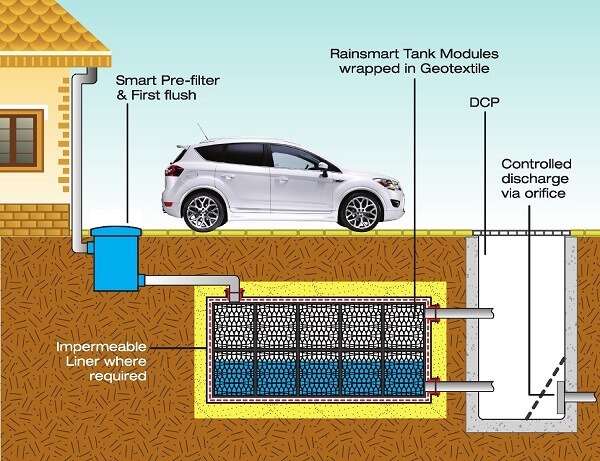
If a site cannot achieve greenfield runoff rates through infiltration or surface SuDS features, attenuation storage (such as an underground geocellular tank or above-ground pond) must be provided to hold back the excess runoff and release it at the greenfield rate. The volume of storage required depends on the difference between pre- and post-development runoff rates across all storm events.
This is why LLFA drainage strategies require detailed hydraulic calculations — to demonstrate that the proposed attenuation storage is correctly sized for all return periods. If you've received an LLFA objection about runoff rates, contact us and we'll review it and advise on what's needed.
Need a drainage strategy or LLFA objection response? We provide planning-ready SuDS drainage strategies across England and Wales.
Get a Free Quote Drainage service →All Services & Resources
Everything you need for flood risk, drainage and environmental planning consultancy across England and Wales.
Flood Risk
Drainage
Other Services
Areas Covered
Need a Flood Risk or Drainage Consultant?
Planning-ready FRAs and SuDS drainage strategies across England and Wales. Free quote within 24 hours.
Get a Free QuoteOr contact us directly: 07826 705389 •